Living in A Loop: Wes Anderson’s ‘Asteroid City’ on Infinity in Life
What is the meaning of life? What is the point? Is there any reasoning behind anything? These are questions that everyone asks themselves at some point in their lives. American Director, Wes Anderson, also asks these questions and comments on them in his 2023 film Asteroid City.
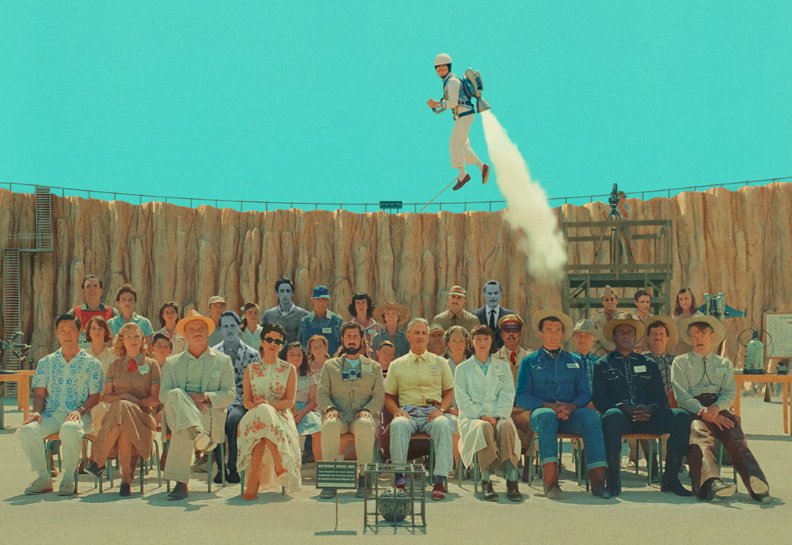
A fairly confusing story with multiple intertwined narratives, Asteroid City, depicts a story about a group of people from various backgrounds coming together in the fictional town of Asteroid City where they come into contact with a mysterious alien. But it’s not as simple as that. This story is actually a play, played by actors who are also acting for a television show and reenacting the behind-the-scenes (and then are also the real-life actors for the movie itself). With his notorious pastel color palette, dead-pan humor, and the usual cast of characters, Wes Anderson dives head first into the style we all know from him with a film that is truly one of a kind and leaves the audience pondering for long after viewing.
We, as humans, are obsessed with trying to find meaning in anything and everything. We are in a constant loop of searching for a purpose, whether that be in traditional media, people’s actions, all different forms of artwork, or our own lives and existence on Earth. Similarly, Wes Anderson’s body of work is also always under close analysis and picked apart for any sort of meaning that may be present.
“It’s about infinity, and I don’t know what else” comments Edward Norton’s character, the script writer for the fictional play within the film when asked what it’s about. This quote may seem simple, but it actually is the pinnacle of the entire movie and explicitly tells the audience exactly what Asteroid City is about. In addition, the cinematography, mise-en-scene, and narrative elements all work together to further this theme and depict Wes Anderson’s views on the human necessity of trying to find meaning.
Mise-en-abyme, a French term first used in 1800s medieval heraldry, is the technique of placing an image inside of another image and creating an infinite loop. In film theory and mass media analyses, this term refers to the idea of a story within a story or otherwise known as an embedded narrative. This idea directly ties into the complicated narrative of the film and Edward Norton’s character, Conrad Earp’s, quote.
Framed window shots are an essential element of any Wes Anderson film but the frequency of their use in this particular movie is a driving factor that supports the themes of infinity. Jason Schwartsman’s character, Augie Steenback, and Scarlet Johansson’s, Midge Campbell, scenes together are often shot in a way where their respective characters are framed within their windows and talking to each other from across the distance between their rental houses. This employs the idea of mise-en-abyme as the characters are framed within the window while also being framed within the actual camera shot as well. Another similar example as this is during the speeches in the meteor crater, there are still images of the characters taken by another character and framed within the shot.
The entire movie itself is even an example of mise-en-abyme with its story within a story framework. The narrative structure of Asteroid City leaves the audience pondering about all the different levels that are shown and perhaps even wondering how much deeper it may go which furthers the idea of an infinite loop. Even the little events that take place in the film can be viewed as nods toward the idea of infinity and mise-en-abyme. The car chase scene happens three separate times throughout the film, each just the same as the last. In class, we speculated this is akin to when a play has a constantly moving background taking place throughout. The Junior Stargazers play a game with each other in which they name a famous person and repeat what everyone says while adding a new one at the end. Due to their high intelligence, this game goes on forever and ever. Both these small bits in the movie that may go unnoticed add to the overall theme of infinity and the idea of a never-ending story.
One of the most memorable moments from the film is the scene in which the actors/characters chant “You can’t wake up if you don’t fall asleep” over and over again. While this scene may seem strange and perhaps out of place in comparison to the rest of the movie, it can actually reveal a lot and shed some more light on the idea of infinity and existing in a loop. This (slightly eerie) chant reminds us of the constant loop that is our everyday lives. We fall asleep, wake up, fall asleep again, and the process repeats itself over and over again until it eventually doesn’t and we are “asleep” for eternity. In order to keep living and experience what life has to offer, we have to stop and sleep. Sleep is necessary in order to wake up again and continue the cycle of living your life. While the entirety of the film is one big existential crisis, this scene really presents the existentialism of living in an utterly explicit way for the audience members to really take it all in. It evokes a sort of unease and discomfort when watching, mirroring the unease we may feel within our lives and the existential thoughts we have about the cycle of living in a constant loop.
It would be no Wes Anderson film analysis without also bringing into question the film’s portrayal of death and grieving, which in this case can also be tied into the themes of infinity and the constant search for meaning. At one point in our lives, we will all feel grief and the other emotions that accompany that. Grief can look extremely different from one person to another, and in Asteroid City we see how grief manifests in the characters. After the loss of his wife, Augie Steenback struggles with telling their children about her passing and connects with Midge Campbell to process and cope with their respective pain. These are the shots in which we see the infamous frame-within-a-frame compositions. The back-and-forth conversations through the windows of these two characters shed light on the importance of bonding with others and allowing yourself to truly feel and express your emotions associated with the loss of someone important.
By being stuck and bound by feelings of grief, we are not giving ourselves the opportunity to keep living and are instead trapped in the loop that it creates. While it is completely rational and okay to allow yourself to feel these emotions, becoming stuck in them halts our development. Sometimes we need to allow our grief to wash over us to keep living; you can’t wake up if you don’t fall asleep. This chant in partnership with the themes of grief tells us that you can’t keep living if you don’t allow things to pass.
The film also offers another take on grief as well. In one scene, Augie is told to “use [his] grief” when practicing lines with Midge. This particular quote and scene suggest that grief should be used as a driving force to motivate and fuel how we go about living. Again, if we allow our grief to linger instead of doing something about it (letting it wash over or utilizing it), we are at risk of living in an infinity of these negative emotions and it becomes difficult to break the cycle. As Augie’s father-in-law, played by Tom Hanks, says, “The time is always wrong”. There is never going to be a “right” time but there comes a point when the cycle must end. Augie must come to terms with his wife’s death by informing their children and allowing himself to do something with his grief.
Perhaps the biggest comment that Asteroid City and Wes Anderson are making concerning the idea of infinity is, as previously mentioned, the human race’s constant need to search and find meaning. Being a filmmaker with an incredibly unique and distinct style, Wes Anderson’s work is always being analyzed and picked apart for any meaning. Even this paper itself is falling victim to trying to understand and make sense of a film. Does the pastel color palette have any actual meaning? Did Wes Anderson specifically choose to have a character stand in a particular position within the frame for an exact reason? What truly is the meaning behind this film; or any film for that matter? Do directors and filmmakers always need a theme and deeper meaning to have a good movie? While not explicitly referred to, these are the types of questions that Asteroid City asks and comments on.
“Just keep telling the story” remarks Schubert Green, the play’s director acted by Adrien Brody. The actor playing Augie in the black and white scenes reflets the audience’s own confusion and struggles with grasping what the meaning is behind this film. Just like us, he is at a loss while trying to understand meaning and just doesn’t get the play that he is acting in. Schubert Green, similar to Conrad Earp, act sort of as a portrayal of Wes Anderson himself and tells us that we should just keep going. We don’t always need to be in the ever constant loop of searching for answers when we can just slow down and take things in for what they are.
In short, Asteroid City and Wes Anderson are telling us that its okay to just have fun, we don’t need a rationale for everything. Similar to processing grief, if we look at artforms such as film with a strong need to find a specific meaning or justification, we are not able to truly process and experience things for what they are. Our existence and going through life is already one big loop, we don’t need to add other loops on top of it that will ultimately halt our development and cause us to live in an infinity of seeking something that may not be there. Referring back to Conrad Earp’s quote saying that the play is about “infinity and I dont know what else”, sometimes it is okay to not know. Sometimes the unknown is good and will allow us to truly experience art and life as it should be; with an understanding that it may not mean anything.
December 20, 2024