Unveiling The Monster Under The Mask: Deconstructing Gender Representations in The ‘Scooby-Doo’ Universe
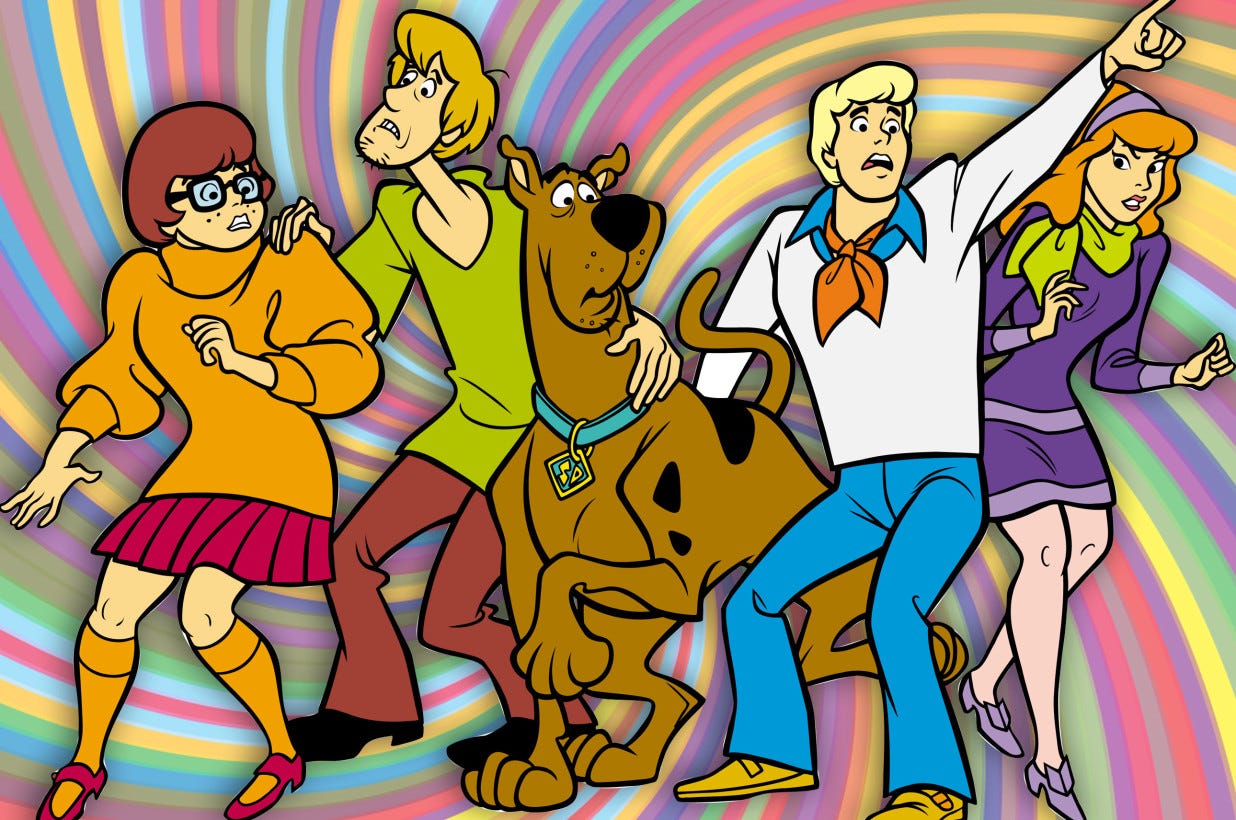
The franchise of Scooby-Doo has risen to superstar status through the years. From the original series broadcasting in 1969, numerous other series have followed as well as an onslaught of books, merchandise, movies, video games, and more. Scooby-Doo was even a star factor and contributor to the cartoon production studio, Hanna-Barbera.
The franchise centers around a group of five individuals who work together to solve mysteries and unmask ghouls, ghosts, monsters, and other entities. Titled the “Mystery Gang”, this group consists of Fred, Daphne, Shaggy, Velma, and of course, their Great Dane named Scooby-Doo. The intent behind the original release of the franchise/series was to create a children’s show that was not overly graphic and violent but also not too soft and still contained the slap-stick style of physical comedy that was popularized during this time.
Scooby-Doo Where Are You was released in 1969 and became an instant hit. Scenes of haunted houses, eerie atmospheres, and ghoulish and monstrous creatures were complimented by humor, dynamic teamwork, and silly gags to create a show that appealed to both a young and older audience, but more importantly a genderless audience. The show was loved by boys and girls alike which was (and occasionally still is) typically uncommon.Following the success of the original series, Scooby-Doo is still popular and is being remade even to this day. For the past 50 years or so numerous spin-offs, movies, and series have been released with the most recent being Max’s original Velma series. Every generation starting from the 60s has grown up and been influenced by the Scooby-Doo franchise in some way or another, creating a universal experience.
This paper will be conducting an analysis of gender representations, sex roles, and stereotypes presented in the Scooby-Doo franchise. The paper will analyze and comment on each of the five main characters in Scooby-Doo as well as what the message to the audience is from the franchise and the overall beliefs it reflects and further enacts.
To do so, it will pull theoretical concepts from several articles and texts that were read and discussed in class. These texts include Rosalind Gill’s ‘Postfeminism Media Culture’, Gaye Tuchman’s ‘The Symbolic Annihilation of Women by the Mass Media’, Emily Contois’ ‘Creating A Dude Chef Food Network’s Guy Fieri’ and ‘Gender, Consumption, and the Great Recession Era of Corporate Food Marketing’, and lastly, Geena Davis Institute’s ‘Rewrite Her Story’ and ‘If He Can See It, Will He Be It?’ reports.
Concepts of femininity as a bodily property, the makeover paradigm, symbolic annihilation, reflection hypothesis, the ‘dude’ identity, and relational masculinities will all come into play throughout the analysis and will be expanded more in-depth when concerning the characters in the franchise. This paper will also highlight the importance of taking a critical analysis of children’s television and media and how representations in media affect and shape children.
The Scooby-Doo franchise and series have had a monumental impact on children’s television and media. It has gone to show that series and other digital media do not have to target a specific gendered audience and adhere to the stereotypes of other media targeting that audience. Scooby-Doo was not a show only about either boys or girls nor was it a show only for either boys or girls. As even stated by Sarah Michelle Gellar, actress for Daphne Blake in the live-action films, “It was so ahead of its time. It had a story, they worked hard to figure it out—and it wasn’t gender-specific. It wasn’t a boys’ cartoon or a girls’ cartoon, or any of those things” (Smith, 2021). Through the show’s characters and themes, children of different genders felt a sense of connection and enjoyed the franchise.
Despite this, however, there are still very gendered representations within the franchise that might not be noticed without deeper analysis. It is important to delve deeper into children’s media as childhood is a very developmental stage and during this time ideas, beliefs, and structural/cultural thoughts and actions are implanted into the mind. Additionally, television is more than just a source of media entertainment. It is a reflection of cultural norms and values and is a representation of societal views that aid in spreading those views. The information and beliefs that are gained during childhood affect how humans think and act throughout the rest of their lives. Tuchman notes that all available evidence points to the media encouraging sex-based stereotypes and that children by age 15 consume more hours of television than time spent in the classroom (Tuchman, 1978).
By applying the theoretical concepts mentioned previously to Scooby-Doo, this paper hopes to demonstrate that even “non-gendered” media is still very gendered and that there is more than what meets the eye. Breaking down each character presented in the franchise as well as deconstructing what the franchise and brand itself say to their audience will allow a look deeper into how stereotypes of gender and gender roles are portrayed in media and how this simultaneously affects and reflects our society’s view on what it means to be a certain gender.
The Mystery Gang includes Fred Jones, Shaggy Rogers, Daphne Blake, and Velma Dinkley along with their dog Scooby-Doo. Together they work to solve clues and unmask monsters to reveal criminals. At first glance, it may seem that the franchise has good gender representation due to the inclusion of two female leads. However, after further character analysis, we can see how not only are the female characters stereotyped and symbolically annihilated, but the male characters are stereotyped as well and may influence harmful beliefs and behaviors toward the show’s young and impressionable audience.
Daphne Blake is a red-haired, purple-dress-wearing, damsel in distress. Despite being a main character she unfortunately has no meaningful contributions to the team. While many women are condemned by the media, the few that do get the spotlight are trivialized (Tuchman, 1978). Daphne is subjected to symbolic annihilation as she is constantly presented as someone who needs to be protected and saved. Almost every episode of Scooby-Doo follows the same plot where Daphne gets captured and then saved by one of her male counterparts. She is almost always the victim, in need of rescue. She is portrayed as incompetent, not only in relation to Fred and Shaggy but to Velma and even Scooby as well.
It seems as if one of Daphne’s very few personality traits is her body figure and subjection to sexual desire. Her character is presented as very feminine but is done so by highlighting her bodily property. Her feminine identity is represented not through her “social, structural, or psychological” properties (Gill, 2007) but through her slim, white figure. Throughout the different shows and movies Daphne is shown in revealing outfits including bikinis (while Velma and other characters are not), often tied up and gagged when she is captured, and even straightforwardly sexualized by her male friends. There are two scenes in the Scooby-Doo movie from 2002 where Fred’s spirit enters Daphne’s body. While in her body he exclaims “Hey, I can look at myself naked!” (Gosnell, 2002) and then in a later scene, moves her hands down her body and holds her breasts while smirking. This strong focus on Daphne’s body is related to what Gill calls “the pervasive sexualization of contemporary culture” (Gill, 2007) as even though this is a children’s franchise, it has a very sexual address.
While some audience members may think Daphne chooses to represent herself as such and enjoys being feminine in a way that is defined by her body, it is important to remember the context of the show. The show originally premiered in the late 60s and was created by a man. If the franchise wanted to show its audience that even traditionally feminine girls can be leaders and main characters, then Daphne would have more character depth and importance to the plot than just being sexualized and in need of rescue.
Alongside Daphne is the other female character, Velma Dinkley. With glasses, a bob haircut, and an oversized orange sweater, Velma is Daphne’s complete opposite. She is the brains of the group and she always finds clues and solves mysteries. Despite her intelligence and worthy additions made to the team, she is highly overlooked by her friends and even the audience. There are relatively very few female representations in media of women having responsibility and authority, so while Velma somewhat breaks this stereotype, her work and actions are discredited and oftentimes attributed to Fred instead. In the 2002 movie, the gang breaks up due to Fred taking credit on live television for Velma solving the entire case on her own.
In a study done by the Geena Davis Institute on female representation in television, they found that more female leaders are shown as intelligent compared to male leaders (Geena Davis Institute, 2019). This is certainly true in Velma’s case with her male counterparts, so then why are the men always given the credit and shown as the saviors? Velma’s character can be very limiting for girls who consume Scooby-Doo media. Although they can be smart female leaders, they will not be awarded with the credit they deserve and will instead be handed to the men.
There is a lot of fan speculation about Velma’s sexuality. Although the show creators did not do this, many viewers have headcanons or assumptions that Velma is lesbian. This is because she is the opposite of Daphne. She has no intense focus on her bodily properties nor does she serve as an object of male sexual desire or show desire for men. So therefore, any female character that does not display an intense attraction to or from men must mean she is then not interested in men at all. The second movie combats this by showing a male love interest for Velma, but she undergoes the makeover paradigm to gain his attraction. In the 2004 film, Velma has a date with a man and she gets transformed with the help of Daphne. Instead of her sweater, skirt, and knee-high socks, she is now wearing an orange, extremely tight-fitting bodysuit with her hair straightened and without her glasses. The makeover paradigm requires that women must believe their lives are lacking in some way due to their appearance and they must undergo a change to fix it and gain expertise from those who are professionals in this field (Gill, 2007) as we see in this scene where Daphne transforms Velma.
The 2002 movie positions Velma’s unconventionally attractive appearance almost as a porn category when in comparison to Daphne. Daphne is the stereotypical sexy one while Velma serves as the nerdy girl that is fetishized. This is shown when Velma and Fred are having a conversation about his attraction towards Daphne and he states “Dorky girls like you turn me on too” (Gosnell, 2002).
At first a seemingly great representation for strong and smart female leaders, Velma is often highly looked over, used for the success of her male counterparts, not desired in the same way as conventionally feminine women, and assumed to not like men due to her lack of over-sexualization. But even when she does show interest in a man, she must first change everything about her looks to become a more conventional feminine identity.
Fred Jones is the ascot-wearing leader of the gang, always giving orders, dictating who does what, and following the likes of stereotypical men in leadership positions; he thinks he is the best. As mentioned previously, he often takes credit for the hard work of others, specifically Velma, and positions himself as the gang’s hero. Fred aligns with society’s traditional sex roles as an “instrumental” leader (Tuchman, 1978) through his leadership and decision making. He can even be seen as the breadwinner of the group since he is more oriented towards the public sphere within the cinematic universe than the other members and serves as the main face (Contois, 2020).
Acting and looking “tough” is also a big characteristic for hegemonic masculinity and for Fred. Not only does Fred look the part of male toughness due to his strong build with muscles, he presents himself in a way showing that he is not scared like the rest of the gang, will take part in risky behaviors, and puts on a brave face when met with danger. Studies from Geena Davis Institute (2020) have found that in children’s television male characters are more likely than female characters to take part in risky actions (setting traps and chasing after culprits) and less likely to show emotions (being scared).
As previously mentioned with the comments Fred makes about Daphne and Velma in the movies, he has a very casual attitude towards sex and attraction, another trait common with hegemonic men (Geena Davis Institute, 2020). These off-handed remarks about the girls’ bodies and looks demonstrates how he does not see them as concerning and harmful as they actually are. Daphne and Velma are not only his colleagues but also supposedly his good friends yet his words treat them as sexual objects of his desire and are a small glimpse into thoughts he has about them in his head. His nonchalant way of saying these things, as well, reveal that he expects no consequences and that he believes these are normal and okay things to say aloud, let alone think.
As the womanizing and leading man of the gang, Fred displays his traditional masculinity loud and proud. While he serves in this role he “subordinates and marginalizes women, as well as men who are not white, middle class, or heterosexual” (Contois, 2020). Daphne and Velma, as well as Scooby and Shaggy as they don’t fit the hegemonic standards of masculinity, are marginalized under Fred’s ruling. Their contributions to each case are often shrugged off by Fred or taken as credit for him instead and they are therefore seen as less.
The dynamic scaredy-cat sandwich-eating duo, Shaggy Rogers and Scooby-Doo are the heroic slackers of the gang. Shaggy and Scooby break the traditional molds of masculinity with their “dude” identities. While Fred is a “real man”with his triumphing leadership, the duo just abides (Contois, 2020). Shaggy and Scooby are not the breadwinners of the group as even Daphne and Velma make more meaningful contributions than they do. Yet their relaxed slacker characteristics still seem to get them somewhere. As the rest of the gang splits up to find clues and solve the mystery, Shaggy and Scooby can often be found distracted by food, potential love interests, and being held back by their fear. They thwart the expectations and responsibilities that are synonymous with traditional manhood and adult age (Contois, 2020). Instead of being tough and putting on a brave face, the duo often hides and cowers in fear and has to be bribed with treats to participate in mystery solving.
The duo also does not ever face consequences of being slackers. The rest of the gang will oftentimes laugh their actions off. If there is any repercussions it will only be a small remark about their actions. So while Shaggy and Scooby break the dominant narrative of masculinity, they still uphold the power that comes with being a man while being complicit with “the overall structure of power and inequality” (Contois, 2020). If Daphne or Velma slacked as much as Shaggy and Scooby do they would surely face consequences and be reprimanded by Fred and even the audience.
It is also important to note the history behind the “dude” identity. Contois notes that in the 1950s is when “dude” became another term for “guy” but was a stolen term from African American culture. Similarly, words like “groovy” were also appropriated and used by dudes. We can see this appropriation very clearly in Scooby-Doo as Shaggy is the embodiment of what a “dude” is and one of his main catchphrases happens to be “groovy”. Additionally, when put into the context of the time period of when the franchise first originated in the late 60s, we can see how Shaggy’s character is a countercultural form of “dude” identities within a “druggie” subculture. Throughout the live-action movies there are multiple allusions to Shaggy being a stoner and smoking marijuana.
While placed next to Fred, we can view how there are relational masculinities. Contois explained the concept in terms of Guy Fieri positioned with his other male chef co-stars as Guy differed from the norms of masculinity. The same can be applied to Shaggy and Scooby when placed with Fred. Shaggy and Scooby’s characters show that there is a different way from the normative way to be a man and still reign superior over women. Shaggy is lanky with long hair and an untamed chin beard while Fred is very put-together. The duo is often frightened and even crosses into characteristics of femininity. Fred is a “real man”. Shaggy and Scooby are allowed to be different from Fred and still be better regarded than their female counterparts. These examples of differing masculine traits demonstrate how relational masculinities can co-exist and still subordinate and marginalize women.
With the context of the time era of when Scooby-Doo first was premiered, it is no wonder that all the characters display the dominant gendered narratives of the 1960s. With this still in mind though, the original series was a sort of monumental phenomenon for children’s television and media with the inclusion of female lead characters alongside male lead characters. Boys and girls alike took enjoyment in watching Scooby-Doo in their living rooms, asking for franchise merchandise for birthdays and Christmas, dressing up as the characters for Halloween, and so on.
Even with this groundbreaking occurrence, we cannot look past the messages that are sent to the audience members of primarily young and impressionable children. With portrayals of men as leaders who always end up saving the day, women being sexualized and having their hard work discredited, and even showing a large majority of the villains as men, Scooby-Doo sends harmful messages to its audience. Shaggy and Scooby teach young boys that they can slack off, goof around, and not take things seriously and still reign superior over women and be rewarded for their unhelpful behavior. Learning from Fred, young boys may become influenced to think that making harassing comments towards women is okay, you should always act and look tough with a role in leadership and decision making, and to take credit for work made by your counterparts. Velma shows young girls that although you can be intelligent and make meaningful contributions to society, they should not expect to be given credit or thanked for their work and instead it will be used to benefit men. From watching Daphne be highly sexualized with no depth to her character, young girls may believe that their worth is rooted in their physical attractiveness and to be feminine is to adhere to the male gaze.
Beginning in the late 60s and still being re-adapted to this day, Scooby-Doo holds a huge role in most people’s lives. As new adaptations are created throughout the years we can see some of the characteristics presented in the Mystery Gang change. For example, Fred has become to be made out as more stupid and oblivious to things than him being smart and alert as shown in the original series. Daphne is given a bit more character depth and worth by having her character utilize martial arts when facing off against the villains. The villains themselves have grown from just being male to being an almost equal mix of male and female. While these changes are moving in a good direction, there is still a lot of work to be done to allow for fair, accurate, and positive gender portrayals.
Scooby-Doo has always been a huge part of my childhood and is still something that I enjoy to this day. While I love Scooby-Doo and owe a lot of my media enjoyment to the franchise, it is also important to think about the deeper ideas that are presented and that have influence over audience members. At face value, the franchise seems like a great representation of multiple genders and is for boys and girls alike. With analysis through the lens of gender studies and communications studies, it becomes more and more apparent that there are many issues and harmful stereotypes displayed throughout the cinematic universe.Just like anything else, media texts aren’t always black and white. Things can simultaneously be both good and bad, something that is certainly true for Scooby-Doo. It is okay to love and appreciate something and still recognize its flaws. By being able to be aware of the flaws and take texts into a critical analysis, that perhaps shows the love you have for it even more than not doing that at all. Analysis allows for a better level of understanding and can aid in creating a more nuanced and robust opinion.
May 14, 2024