‘The Graduate’ In a Cultural Context
Released in 1969, ‘The Graduate’ is a romantic comedy directed by Mike Nichols starring Dustin Hoffman, Anne Bancroft, and Katharine Ross. The movie was directly inspired by the 1963 novel of the same name written by Charles Webb. Lawrence Turman’s impulse buy of $1,000 of his own money to make the film led to one of the most successful films ever. Its success of $105 million changed HollyWood and the decision-making that went into them (Scott, 2017). Its consequentiality makes it just as subversive as it was when it came out.
‘The Graduate’ follows many of the same common romantic comedy tropes as its predecessors before it; i.e. masquerades, derailed weddings, and boy meets girl, boy loses girl, boy gets girl back. But where this film truly shines, and earns a name for itself, is in the ways it broke away from the traditional aspects of romantic comedy. Jeffers McDonald argues in her book that this film breaks away from traditional romantic comedy tropes by challenging gender roles and societal expectations that are typical in other rom coms by showing a man exploring his sexual awakening with an older woman.
‘The Graduate’ has been dubbed as “the radical romantic comedy” due to its change and shift of featuring social and cultural contexts of the time period (Grindon, 2011). There is an absence of direct references to the Vietnam War, hippy culture, and drug use, all of which were very prominent events during this time period (Grindon, 2011). But, in fact, the film displays the ideas of counter-culture present in the youth to these events.
Post World War II, there was an abundance of job opportunities and people’s main focus was to work hard and strive for a good living standard. Due to the results of the Vietnam War, however, many people shifted their focus onto their children instead. Parents want what they think is best for their kids, in this case a materially successful and comfortable life. Kids of this time had basically no control over their lives and were doomed to follow in their parent’s footsteps despite wanting more for themselves.
‘The Graduate’ shows the struggles and desires of college kids of that time perfectly with the character of Benjamin Braddock (Dustin Hoffman). During the scene of Ben standing poolside with a family friend, McGuire, we gain an inadvertent metaphor of Ben’s life. McGuire lends him some friendly advice on pursuing a career in plastics. Ben is struggling with entering the world of adulthood and the materialistic and conformist lifestyle that comes with it. He is not interested in living a “plastic” life; a life that lacks fulfillment and authenticity.
Ben, as a representative figure for young people of his time, is searching for an identity that is not shared with his parents. He views their materialism as reflected in their suburban lifestyle (Beuka, 2000). We can see parallels of the suburban landscape with the cultural sense of imperiled masculinity. Because of Ben’s feeling of being alienated from the world, this causes him to seek out and pursue taboo sexual encounters with Mrs. Robinson (Anne Bancroft) in hopes of finding his sense of self and being able to break free and feel different.
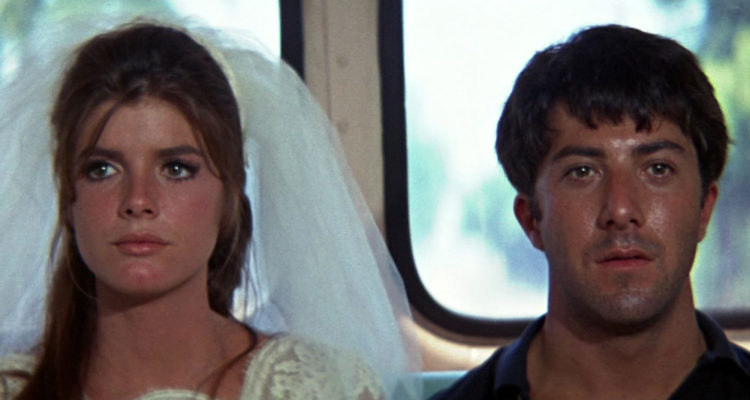
Later in the film, the last scene also highlights the milieu of suburban adulthood as Ben breaks up Elaine’s (Katharine Ross) wedding and runs away with her. The moment when we see both Ben and Elaine sitting on the bus with weary looks on their faces can be read as both victory and defeat. They may both be escaping the worlds that their parents have created for them, or perhaps they are headed towards and driven further into that “plastic” world they so badly didn’t want. The unknowingness of the character’s feelings and future further defines the culture of the youth as their dissatisfaction with materialism and conformity is fueling their fear of adulthood.
An interesting symbol of the suburban milieu shown mostly throughout the first half of the film. A lot of shots take place poolside, possibly Nichols using it as a reminder of the significance of suburbia (Beuka, 2000). Even as Ben tries his best to not be confined to his parent’s lifestyle, it is almost impossible to escape. We can also see cutscenes and shots of Ben lounging by or in the swimming pool between scenes of him with Mrs. Robinson, further reiterating and contrasting his transgressive behaviors with what is “meant” for him.
A second prominent yet often overlooked and forgotten about part of the film in relation to historical and cultural context is the psyche and relationships of the female characters; Mrs. Robinson and her daughter Elaine. ‘The Graduate’ can be observed and analyzed as a document of the early second wave feminist movement of the 1960s (Cash, 2019). Being released in 1967, the film highlights the sensitivity to the generation gap, radicalization of sexual mores, and the search for authenticity. Mrs. Robinson and Elaine offer great insight into these aspects of the decade yet get left behind in the shadows of analysis and commentary.
Despite Mrs. Robinson having a privileged status being a white upper-class suburbanite, she also displays how women had limited options due to living in a post World War II era. She was entirely financially dependent on her husband and the film shows how suburban women lacked a sense of fulfillment (tying back to how parents wished for their kids to feel fulfilled). Societal pressures that enforced gender roles restricted women from pursuing careers, gaining their own financial independence, or achieving their own desires. Due to Mrs. Robinson feeling trapped and unfulfilled, she seeked out a sexual relationship with a younger man. Another interpretation for Mrs. Robinson wanting to form this relationship with Ben is that she is yearning for youth, jealous of her daughter and therefore acts possessive over Ben.
Elaine’s character demonstrates the conflicting messages that many young girls of the generation were facing. Watching their unhappy mothers such as Mrs. Robinson left young girls feeling confused and uncertain about their parent’s lives but also their own future prospects. Am “I going to turn out that way?” was a probable question that Elaine, like many others, wondered about themselves.
Elaine embodies the struggle to make choices that her mother was denied. While Mrs. Robinson urged her daughter to choose and marry the right husband; she showed dissatisfaction with her own life. However Elaine was determined to forge her own path. Young girls rejected the idea that they had to follow in their mother’s footsteps and ‘The Graduate’ shows how these girls were determined to be independent and make their own decisions. The relationship between Mrs. Robinson and Elaine represent what is called the “female generation gap” which differs from the generation gap of Ben and his father (Cash, 2019).
We also see a glimpse into how women were viewed during the 1960s. Despite young men like Ben upholding fairly left-wing ideologies, their views towards women still remained slightly misogynistic. Elaine’s perspective is often disregarded by Ben and is bulldozed over due to his lack of understanding. When Elaine is torn between despising and wanting to marry Ben, stating “I don’t know what’s happening”, he glosses right over how she may feel and says back “Don’t be confused, we’re getting married”. This shows how women’s thoughts and opinions were often dismissed or belittled by men; a result of gender roles and further showing the generational gap as this is Ben’s thinking being shaped by his father’s.
The contrast between Ben and Elaine’s perspective is a huge part of showing the societal norms of the time. In the wedding crash scene, even though Elaine is calling out Ben’s name and running through the crowd, deep down she knows that she does not wish to be a bride. This is further empathized when they are both sitting on the bus, Ben appears tired yet content whereas Elaine has a look of uncertainty and unease. The tension is at an all time high as they sit side by side yet apart from each other.
For women like Elaine, there were few role models to follow outside of marriage and motherhood. Her uncertain future can be seen as a metaphor for the uncertainty felt by women of her generation as they sought out to create a new path for themselves.
‘The Graduate’ is surely one of the greatest, not only romantic comedies, but films of its time. Without displays of overly recognizable references to historical and cultural aspects of the generation, it still achieves a wonderful craft of what life was like for the youth post-war. The use of subtlety does an excellent job at allowing audiences to analyze and connect with the characters. Ben Braddock shines as a figure of wanting to break free from your parent’s clutches and create your own future, one with authenticity and uniqueness. The female characters, Mrs. Robinson and her daughter Elaine, are strong representatives of how the war impacted how women were perceived and therefore how their lives were set out for them. Overall, ‘The Graduate’ and its characters stand as a great time capsule and glimpse into what it was like to live during the 1960s.
April 20, 2023