Selling Simulacra: Analyzing ‘Nightcrawler’ Through Baudrillard’s Framework of the Hyperreal
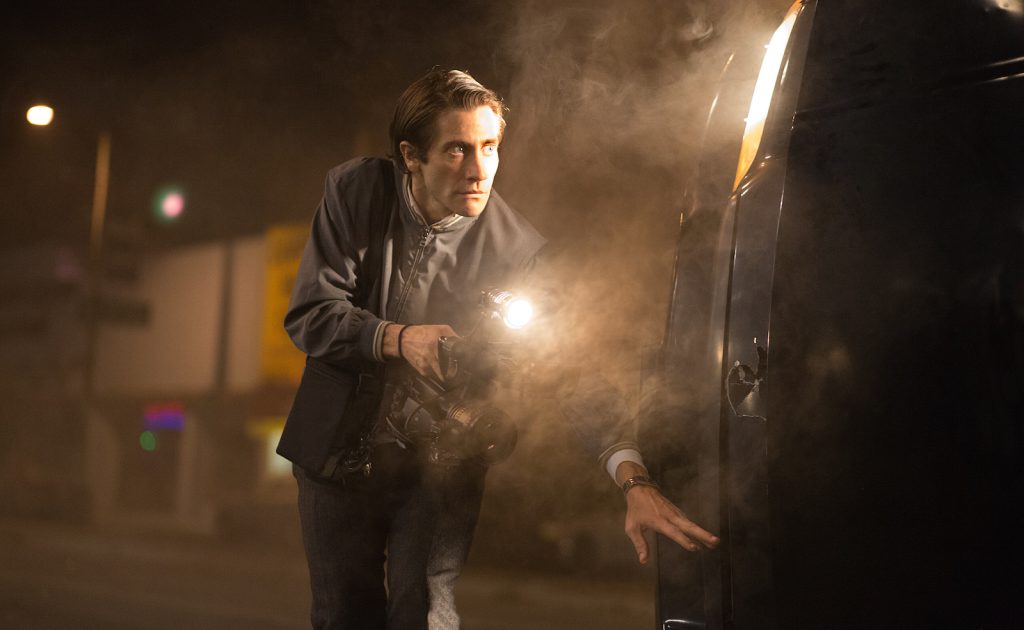
At what point does reality blur with what is artificial? Do we ever notice? The barrier between truth and spectacle diminishes within the cinematic world of ‘Nightcrawler’, a film that may not be so farfetched and fictional. Through textual analysis, we can explore the nature of hyperreality presented in the film through Jean Baudrillard’s theories of the simulacra while touching upon hyperreality, media manipulation, and loss of referentiality.
Traversing through the streets of Los Angeles, Louis Bloom is an adventurous stringer who would not stop at anything to capture eye-catching footage. Bloom actively seeks out and records scenes of crime and accidents at night to sell to a local TV news station. As the stakes and money increase, so does the pursuit to obtain captivating coverage; even if that means manufacturing it himself.
The concepts Baudrillard discusses in his text (1994) can be applied to the film as he highlights ideas such as simulacra as hyperreality, media manipulation, and the loss of referentiality. All these three concepts become apparent when watching the film with Baudrillard in mind.
Baudrillard’s ideas surrounding hyperreality are that the distinction between reality and simulation can sometimes end up being blurred. It can become so blurred that the simulation may even overtake the real. In a hyperreal world, people may find it difficult to discern between what is manufactured and what is manipulated, which in turn can lead to senses of manipulation and being misled. Due to the simulated being indistinguishable from the real, meanings fade and lose their power. Media saturation, technological advancements, and consumer culture are all contributing factors to the phenomenon of the hyperreality, which is also true for the hyperreal world of Louis Bloom in ‘Nightcrawler.’
“To simulate is to feign to have what one doesn’t have” (Baudrillard, 1994) is a perfect quote from Baudrillard’s work to understand Louis’ extreme determination for the perfect footage. As the TV news channel is increasing its expectations for what it wants to broadcast, Louis is running out of adequate cover-story material to provide. He doesn’t have what they are asking for, so instead he simulates it. This becomes very dangerous as “simulating is not pretending” (Baudrillard, 1994), in order for Louis’ work to be bought he has to entirely construct his own scenes. One example of him doing so is when he tampers with the van of his rivals so it crashes, therefore allowing Louis to race to the scene and capture the flames and destruction that he created. Soon, these manufactured and exaggerated realities take over the news station and overtake the actual, real events leading to media manipulation.
In one scene when Louis Bloom is watching the news station air footage that he has captured he stares at it in awe and remarks that “it looks so real”. This just further shows how something so manufactured and simulated can begin to take shape as reality and get to a point where society may not even know what is real anymore. This also just goes to show how our media sources manipulate what we see and create false realities for us to consume and therefore believe are real and factual.
In ‘Precession of the Simulacra’, it is argued that media no longer reflects reality but instead creates and spreads its own hyperreal imagery. Media manipulation accelerates the precession of simulacra (simulation overtaking real) by shaping our perception of reality. When fake/manufactured images are repeatedly seen and spread around, they splice from any original or real referent. Baudrillard mentions the orchestration of the media and how these orchestrated broadcastings of events lead to possible consequences as well as the “dissolution of TV in life, dissolution of life in TV” (Baudrillard, 1994).
Louis is constantly contributing to the manipulation of media as he shoots and sells manufactured news footage to the network. This leads to a state where the authentic and the simulated can no longer be told apart and those who consume these false portrayals in media are both victimized and essentially brainwashed. The fake reality of these crimes and accidents actually happening then has even wider consequences as it shapes the culture of society. People who watch the news network will begin to believe that their world is really like what is being presented to them; a world of crime and corruption. As viewers consume more media of these horrific scenes, it creates a type of fear-mongering. The population will become so obsessed with hearing about crime that they will tune into watching more and more often and are constantly being fed false narratives. It is a non-stop perpetuation of feeding into people’s disillusionment; as Baudrillard states, “TV is watching us, TV alienates us, TV manipulates us, TV informs us…” (Baudrillard, 1994).
Furthermore, this idea of media manipulation is also shown when Nina, the morning news director, creates a false story from Louis’ footage which is already a false narrative to begin with. There are layers of manipulation that are going into what is being broadcasted to the public. Louis begins by tampering with evidence, shooting things in a particular manner, and even causing his own crime scenes. Nina is unaware of how Louis has been gaining his footage so on top of that manufacture, Nina then has the station edit and show the footage in a particular manner. In one scene Nina explains how a stabbing in a poor neighborhood is not what the station is looking for, instead, she will alter the story and make the headline “crime creeping into the white neighborhood.”
Loss of referentiality, as Baudrillard explains it, is that signs and symbols no longer point to any sort of reality but instead point to other signs. He provides an example of a bank robbery and says that even if the robbery is entirely simulated and faked, it will still come across as a real robbery to the public. In terms of media, circulated signs and symbols get detached from any original referent and do not represent anything actually real. They create their own meaning and reality. This concept challenges notions of truth as there is no longer a fixed reality to which signs can refer to. This ends up resulting in a society with a hyperreal environment where simulations increasingly emerge and dominate, further adding to the elusiveness of simulation and reality.
This is true in ‘Nightcrawler’ as the footage of crime scenes and accidents doesn’t point to any actual real event. They become so divorced from actual incidents that they lose any reference. In one scene of the film, Louis Bloom arrives at a crime scene where the perpetrators are still there. He decides to wait until they flee the scene instead of calling any authorities and makes his way inside the home with his camera where he captures footage. Louis tampers with the evidence, moves items such as weapons around, and essentially creates a whole new scene than what really happened. He does such a “good” job manufacturing the scene that the news network loves it, airs it, and again there is a demand for even more product from Louis. The non-stop broadcasting of sensational and eye-catching content contributes to obscured or even lost meaning. These broadcastings perpetuate “a world where there is more and more information and less and less meaning” (Baudrillard, 2014).
In comparison to Baudrillard’s example of the simulated bank robbery, Louis Bloom’s crime incidents are very much similar. The events such as the van crash and tampering with evidence become so simulated that there is no way to distinguish them from being real and not manufactured. When the public watches the news station they will not be able to discern the difference between coverage of a real crime scene and one that Louis Bloom has crafted.
The concepts presented in Baudrillard’s ‘Precession of the Simulacra’ are not only apparent in the fictional universe of ‘Nightcrawler’ but also in our world as well. News channels may not fake scenes to such an extent that Louis Bloom does, but that does not mean our news is entirely reliable either. The film provides a great look into how the media exaggerates and alters stories to become more interesting for the public. A particular scene in ‘Nightcrawler’ that is a great example of this is when Nina talks into the earpieces of the reporters and tells them what to say and do to build suspense and emotion for the audience. She also makes decisions to edit footage Louis gives to her to construct her own story that she thinks will sell. There’s no doubt that news and media companies do this in our society as well to attract and keep viewership.
The intertwined narratives of ‘Nightcrawler’ and ‘Precession of the Simulacra’ illuminate a striking connection between cinematic portrayal and theoretical text. An insatiable appetite for sensationalism from the news network transforms crime scenes into entirely staged performances. The network becomes referential of itself as the media dictates the narrative rather than reflecting a reality from beyond their headquarters. The calculated manipulation of media consumption due to Louis Bloom’s strive for success and popularity is a chilling reflection of Baudrillard’s work.
We are now left to ponder and take into consideration how our own media manipulates us. Baudrillard’s theories are not just theories as they have become even more increasingly apparent in our everyday lives. It is an unsettling realization to live with that the narratives we consume may not entirely (if even at all) reflect reality but instead actively participate in its construction.
December 21, 2023